
Adam McKay recently published a piece in Current Affairs arguing that the most dangerous climate lie today is not that the problem doesn’t exist.
It’s that we have the luxury of time.
His point is that the urgency mandated by the science is being undercut through omission, political caution and a sense of false security. Climate change is acknowledged, but the message absorbed by much of the public remains something closer to: yes, this is happening, but life basically continues.
I think he is right, to a point. But urgency is only useful if the systems designed for responding to the alarm can signal how individual and collective actions are materially changing the situation. And the reality is that they can’t and don’t.
So once again, we are given another high-profile piece blaming the media and the politicians for public ennui when the real, and more serious, problem is we are trying to manage a whole-system crisis without whole-system feedback.
We are not the only ones saying this needs to change.
Banging the drum
In 2024, Johan Rockström and colleagues published The Planetary Commons, calling for polycentric governance connecting different scales, sectors and jurisdictions. The 2023 Global Tipping Points Report reached a similar conclusion: planetary risks require governance distributed across multiple scales, with information moving between them.
The architecture is self-evident:
planet → nation → region → municipality → neighbourhood → household
Yet climate information moves very poorly between these scales.
We know an unprecedented amount about atmospheric carbon, planetary boundaries and global temperature. National governments have carbon budgets and transition pathways. Local governments declare climate emergencies and undertake programmes. Households are asked to buy EVs, install heat pumps, insulate their homes and change patterns of consumption.
But where is the interoperable data architecture dashboard connecting all of this into a coherent view for citizens to observe and respond to?
A “planetary boundary” has very little meaning to a family if they cannot see how their home, street, neighbourhood, or town relates to it. And a national Net Zero target is difficult to act upon locally if a municipality cannot see whether its own interventions are moving it toward that goal.
The same disconnect appears in the UK's own climate strategy.
The government’s Climate Change Committee's Seventh Carbon Budget estimates that choices directly involving households account for roughly one-third of the emissions reductions required by 2040. The CCC also recognises the need for two-way public engagement and for people to understand their role in the transition.
Yet the stated pathway remains heavily organised around mass-scale deployment: renewable electricity, electrification, and EVs. These things are essential. But the household is still largely where a technology gets deployed or a behaviour gets changed.
What if we thought of the household differently — as an active node in the climate system itself?
If millions of households have to participate in a transition over an extraordinarily compressed period, it seems extraordinary that we have built so little infrastructure allowing them to see that transition happening. Ask yourself these questions:
Can I see whether my town is on course for its 2030 objective?
Can I see whether a council intervention changed anything?
Can I see whether energy demand in my neighbourhood is falling or rising?
Can I understand how changes made by thousands of households aggregate into municipal progress — and how that progress relates to the national pathway?
Most importantly: can I see where I am in the system?
This matters for grassroots mobilisation.
For decades, climate information has largely travelled downward: scientists and governments describe the planetary condition; institutions establish targets; municipalities translate some of those targets into programmes; citizens receive the message at the last stage in the chain.
But people aren't simply endpoints for climate policy. They are participants in the transition.
If we want millions of people actively engaged in changing an enormously complex system, they need agency, context and feedback. They need to be able to see collective movement — or the absence of it — and understand how their actions connect to something larger.
At ORA we build systems that specifically capture and signal the energy and momentum of an ecosystem, distributed across its nested components. In that scalar architecture we can see where the weakest points are and how they interconnect and interdepend on the rest of the network. In the climate context we build climate and resilience systems as a direct response to the demands of groups like Johan Rockström and colleagues, the authors of the aforementioned piece, who very precisely demand a:
polycentric governance approach that connects scales and integrates sectors and jurisdictions, providing an innovative Earth system–focused framework for governing complex, interlinked, multiscalar governance challenges arising from a changing Earth system
When we approached their lab about translating these ideas into a nested, scalar signal — something that could connect planetary condition downward toward the places where governance and human behaviour change actually occur — the response, in essence, was that they didn't see much need for new visualisations.

These are people who are the foremost authority on alerting the world to our penetration of boundaries that is leading to irrevocable climate emergency, and whose dashboard is a 2D image, updated annually, presented on a website no one knows about.

But this isn't about visualisation.
It's about whether a planetary signal that stops at the planetary scale is sufficient for a transition that has to happen in nations, cities, towns, neighbourhoods, businesses and homes.
A Breakthrough in Frome
Over the past year ORA has been working with Frome Town Council, one of the UK's more celebrated progressive local councils. Frome has declared a climate emergency and committed to Net Zero by 2030.
The Council cares deeply about climate change. It has undertaken programmes, supported retrofit activity, planted trees and invested considerable civic energy in the transition.
We asked one basic question:
Is Frome moving toward or away from Net Zero 2030, and at what rate?
Nobody on the climate team could answer it. Not even approximately.
The commitment is there. Data had been identified. The intervention plans exist. But there was no operational system connecting those things into an actionable (and defensible) signal of direction and momentum that can give anyone a sense of where they are at.
This isn't a criticism of Frome Town Council. These are serious people doing critical work inside the same informational architecture available to municipalities everywhere.
But declaring an emergency and announcing a deadline without an instrument capable of showing your progress toward the mandated goal is like racing your dying mother in an ambulance toward a hospital without a fuel gauge.
So they commissioned a scalar dashboard and we got to work. Once we began assembling the system, we discovered how deep the problem went.
We found EPC ratings, but EPCs model building performance; they don't tell us how much energy households are actually using.
We found planting totals, but planting trees doesn't tell us whether ecological condition is improving.
We found wildlife observations, but increasing observations can reflect increasing participation rather than increasing biodiversity.
We found regional (county) renewable statistics, but very few for Frome itself.
We found national electricity data, but national grid performance doesn't tell us whether Frome is meeting its objective.
These distinctions matter. Otherwise it is remarkably easy to build an impressive-looking climate dashboard that cannot actually tell you whether anything is getting better.
Our work eventually became the Frome Climate HALO: a whole-systems observatory designed to distinguish condition from direction, intervention from outcome, and progress from aspiration.
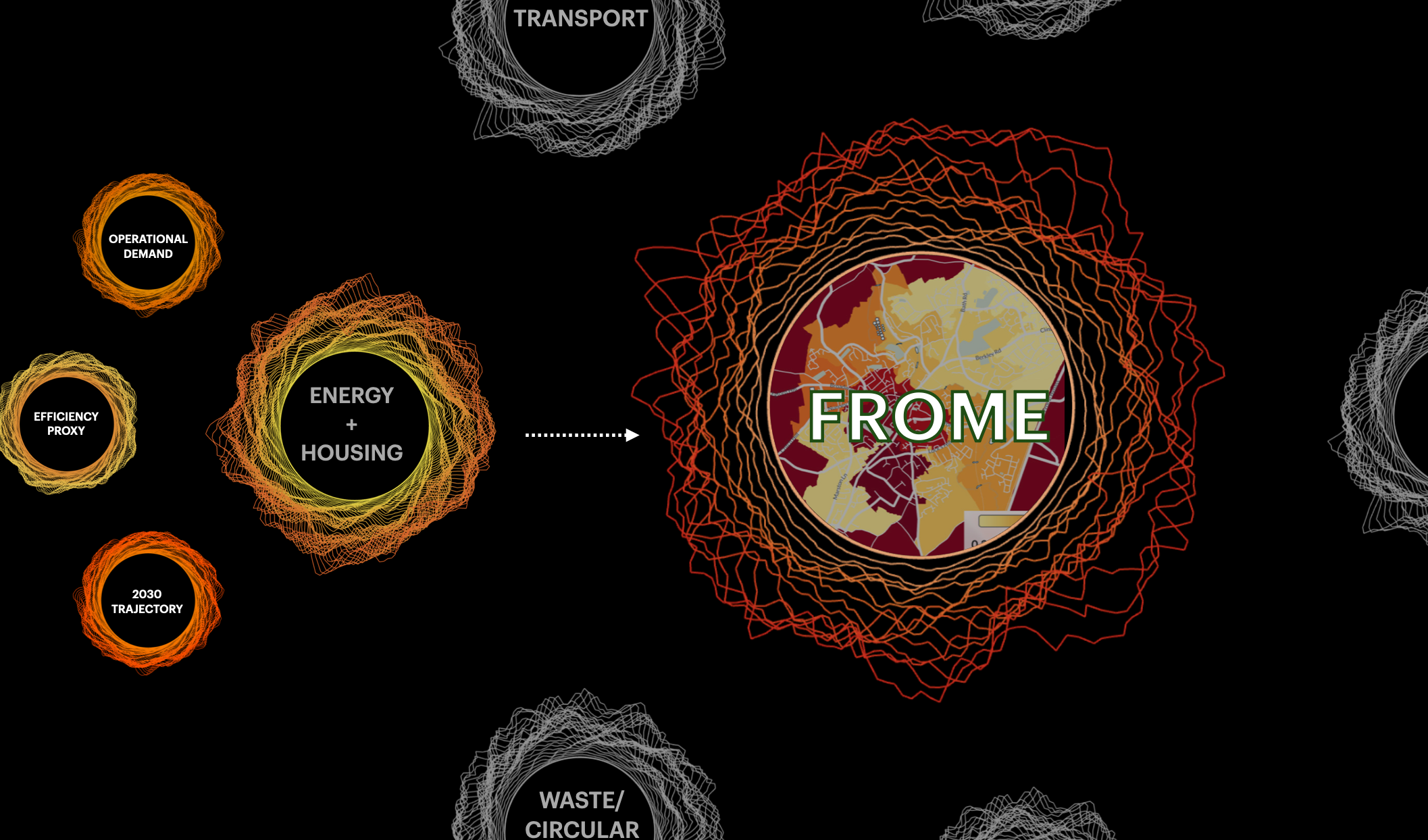
We have deliberately kept the operational system small. Rather than filling it with every climate-related statistic we could find, we started with signals we could defend — particularly real-world energy demand and whether its direction of travel is compatible with the town's 2030 objective.
Where we cannot adequately observe a system, we say so. That is also information. And it has led us back to McKay's argument, but from a slightly different perspective.
He's right to demand much greater honesty about how little time remains. But if the response to that urgency is simply to make the warnings louder, I think we are missing something.
People need to be given clear metrics on how their actions will move the needle, and they need to see that change in real-time, even if it is at the micro-scale. In other words: to meaningfully participate, they need to know whether collective action is producing results. They need to see where institutions are succeeding and where they aren't. And if households really are central to the transition, they cannot remain at the bottom of a stream of increasingly alarming information flowing downward from institutions.
They need to become participants in the signal.
That may be one of the missing pieces in building the grassroots climate movement McKay is calling for: a comprehensible, dynamic signal connecting household action to neighbourhood change, municipal momentum, national objectives and ultimately the planetary system above them.
If climate change is a whole-system crisis, people need to be able to see the whole system — including themselves inside it. Because if governments genuinely believe the emergency is as urgent as they tell us it is, we should also be asking a very simple question:
Why have we built so little infrastructure for seeing whether our response is actually working?
